Guides
AI 3D model generator: seven things to check before you pick one
Seven checks for any AI 3D model generator: inputs, export formats, topology, free-tier limits, ownership and model choice. Test it yourself.
3 min read

Quick answer
How do I choose an AI 3D model generator?
Judge it by what you can do with the file, not by its demo reel. Check which inputs it takes (text, image, sketch), which formats it exports, whether the mesh is cleaned up or raw triangles, what the free tier really allows, who owns the output, and whether you can try more than one model on the same input.
Why the demo reel doesn't help
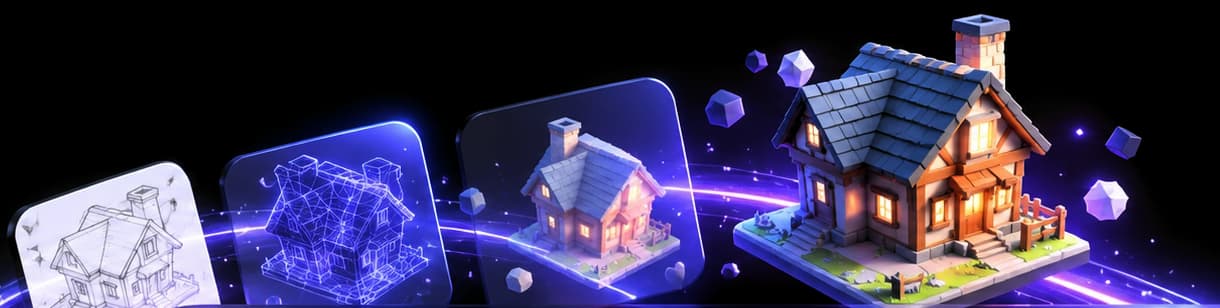
Every generator's homepage shows its best ten results on its best ten inputs. What you'll actually get depends on your input and on what happens to the mesh after generation. These seven checks take about twenty minutes with a free account, and they tell you far more.
1. Which inputs does it take?
- Text is quickest when you have no picture. The tool draws an image first, then models it. Text to 3D.
- Image is best when you have a photo or concept art. Image to 3D.
- Sketch matters if you draw. A rough drawing isn't a photo, and tools treat it differently. Sketch to 3D.
- Several views (front, side, back) cut down the guessing. Multi-view image to 3D.
2. What can you export?
You want at least GLB (web, Godot, three.js), FBX (Unity, Unreal, rigging tools) and OBJ (Blender, printing). If the tool only exports GLB, plan a conversion step. 3D file formats explains which goes where.
3. What does the mesh look like?
Open the export in Blender and turn on wireframe. A raw generator mesh is dense triangles, which are hard to edit, animate or UV. Some tools retopologise into quads automatically. Why AI 3D models have messy topology shows what to look for. Vi3W retopologises every model before export.
4. What does "free" mean?
Count it in models, not credits. How many models does the free tier make? Can you export at all? Is commercial use allowed? Is there a watermark? The limits of free AI 3D generators lists the usual catches. Vi3W's free plan starts with 100 XP, and one model with the defaults costs about 30 XP (an image, then the 3D step).
5. Can you choose the 3D model?
Models fail on different objects. A tool that only runs one model gives you one chance. A tool that runs several lets you retry a hard object on a different model for little extra cost. Vi3W runs TRELLIS, SAM 3D, Hunyuan 3D, Tripo and Hi3D: how to choose between them.
6. Who owns the output?
Read the terms for commercial use, especially on free tiers. If you'll ship models in a game, check the store's rules too: Steam's AI disclosure.
7. Does it fit what you do next?
The generator is one step. If you animate, you'll need a rig (rig an AI character). If you print, you'll need a closed mesh. If you build games, you need sensible poly counts. Test the whole path once, not just the generation.
What no generator does well yet
Thin parts, transparent materials, exact dimensions and mechanical precision are still weak spots everywhere. For CAD-accurate parts, use a CAD tool. For hero characters, expect to sculpt on top.
Try the checklist on Vi3W
Open Vi3W, make one model with the free XP, and run it through all seven checks.
Last reviewed