Guides
Sketch-to-3D vs image-to-3D: what's actually different, and which to use
Sketch-to-3D and image-to-3D compared on input, accuracy, control and cost, with a real side-by-side run and advice on which to use when.
3 min read

Quick answer
What is the difference between sketch-to-3D and image-to-3D?
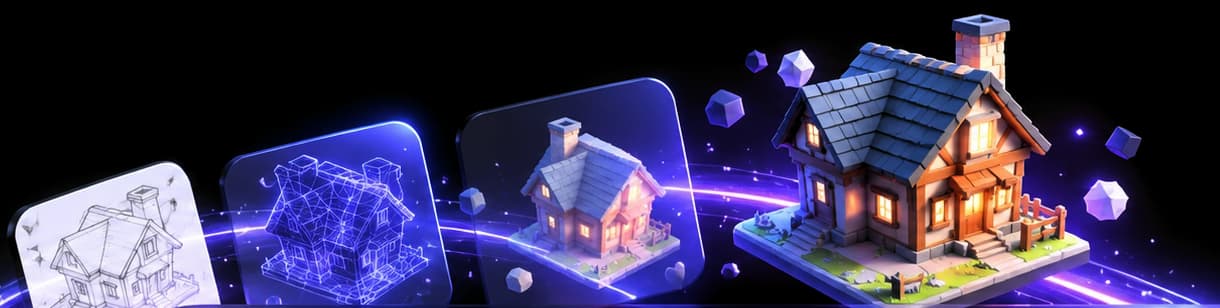
Image-to-3D builds a mesh from a picture that already shows light, material and depth. Sketch-to-3D starts from bare lines, so a good tool first renders the drawing into such a picture, then runs image-to-3D on it. Choose sketch when the object exists only in your head, and image when you have a photo or painting.
At a glance
| Feature | Sketch-to-3D | Image-to-3D |
|---|---|---|
| You start with | Lines: a drawing, doodle or line art | A photo, render or painted concept |
| What the AI must guess | Material, colour, lighting and depth, plus hidden sides | Hidden sides |
| Extra step | Drawing rendered to an image (17 s in our test) | None |
| Cost in Vi3W | 30 XP (10 image + 20 TRELLIS) | 20 XP (TRELLIS) |
| Control over design | High: you drew it, and you can redraw | Limited to the picture you have |
| Fidelity to a real object | Low: it's your idea, not a measurement | Higher, if the photo is clear |
The one-sentence difference
Image-to-3D turns a picture into a mesh. Sketch-to-3D turns a drawing into a picture first, then does image-to-3D. Everything else follows from that.
A 3D model like TRELLIS was trained on images of real-looking objects. It uses shading to work out depth and colour to work out material. A line drawing has neither, so feeding one straight in tends to give flat or lumpy results. 3D AI Studio's own sketch page says as much, recommending an image render first because flat line art "usually yields less reliable meshes" (source).
Seen side by side
We ran both routes in Vi3W on November 9, 2026.
Sketch-to-3D. A dozen mouse strokes of a chest, plus "A wooden treasure chest with iron bands and a lock". Nano Banana rendered it in 17 seconds (the hero image above). The rendered image went into TRELLIS, which returned the model about 35 seconds later.
Image-to-3D. Starts at the screenshot above. If you already have the picture, upload it with Upload your own image and press Generate 3D. The 3D model doesn't know or care whether the image came from your sketch, a camera or a painting.
So the 3D step is identical. The difference is entirely in what you hand it, and how much of that picture is your design rather than a guess.
When to choose sketch-to-3D
- The object doesn't exist yet. A prop, creature or product idea you can draw but can't photograph.
- You want control over the design. Every line is a decision, and you can redraw one part without changing the rest.
- You're a 2D artist. Your skill is drawing. This route uses it.
- You need a set in one style. Drawing each piece yourself keeps the family resemblance.
Start with how to draw a sketch for AI 3D and the hand drawing walkthrough.
When to choose image-to-3D
- The object exists. A product, a toy, a piece of furniture.
- You have finished concept art. Re-rendering it risks drifting from the design.
- You found the look elsewhere. An AI image from Midjourney, ChatGPT or Gemini (AI art to 3D).
- Cost matters. It skips the image step: 20 XP instead of 30 in Vi3W.
Best photos for image to 3D shows how to shoot for it.
What neither route fixes
- Hidden sides are guessed either way. Add a side or back view.
- Thin parts (wires, straps, chair legs) come out thick or missing.
- Exact dimensions aren't measured. Scale the result yourself.
- Static only. Neither route rigs or animates.
And there is a third route: no picture at all, only words. Text vs image vs sketch to 3D compares all three.
Try both routes
Open Vi3W, draw one object and upload one photo, and compare the two results. Between them they cost 50 XP of your free 100.
Frequently asked questions
AI that converts 2D drawings into textured 3D models.
That's sketch-to-3D. In Vi3W, draw or upload the drawing, add a few words, generate the image, then generate the 3D model. The texture comes from the rendered image, so the words you choose decide the material.
Convert a 2D product image into a 3D object online.
That's image-to-3D. Upload a clean product photo on a plain background, skip the sketch step, and generate the 3D model. Expect a look-alike, not a measured replica. For exact dimensions, use CAD or photogrammetry.
Last reviewed