Guides
2D to 3D AI: turning drawings, photos, logos and sprites into 3D models
How AI converts a 2D image into a 3D model, what each kind of picture needs, and when to use extrusion or Blender instead of AI.
2 min read

Quick answer
How does AI turn 2D into 3D?
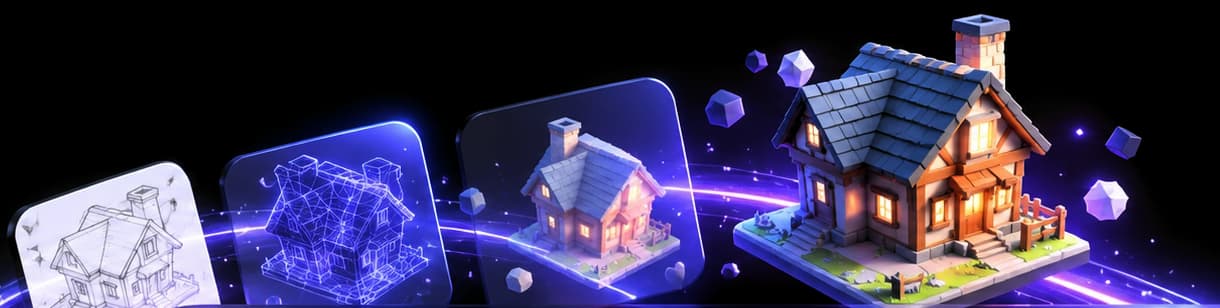
It looks at one flat picture and predicts the missing depth: the shape, the back and the sides. It then outputs a textured mesh. It works on photos, drawings, concept art, logos and pixel sprites, but each kind of picture needs slightly different preparation, because the AI can only model what it can read from the image.
What "2D to 3D" actually involves
A picture has width and height. A model also has depth, and that depth isn't in the file. An AI image-to-3D model has learned, from many 3D objects, what things usually look like from the sides and back, and it fills in the rest. How AI 3D generators work explains the mechanics.
Because it's a prediction, what you put in decides what you get out. Here is what each kind of 2D input needs.
Photos
Real objects photographed well convert best. One object, the whole thing in frame, soft light, plain background. Best photos for image to 3D. For a product: product photo to 3D.
Drawings and sketches
A rough sketch doesn't say what's solid and what's shading. Tools built for sketches clean the drawing into a solid image first, then model it. That's what Vi3W's sketch to 3D does. Clean line art and lightly shaded drawings both work: line art vs shaded sketches.
Concept art and character sheets
A front view plus a side view beats one dramatic angle. If you have a turnaround sheet, use it: character turnaround to 3D, and concept art to 3D.
Logos and flat graphics
Logos don't need guessing. They need extruding: the flat shape pushed out to a thickness. That's precise and quick in Blender or Tinkercad from an SVG. AI helps when you want a sculpted, rounded or stylised 3D version of a logo rather than a flat cut-out. Logo to 3D model covers both.
Pixel art and sprites
A sprite is tiny and has no shading information to read depth from. Either upscale and repaint it as a clean illustration first, or rebuild it as voxels. 2D sprite to 3D model.
Kids' drawings
They convert better than you'd expect, and the result is a great print. Kids' drawing to 3D model.
When not to use AI
- Exact dimensions, like a bracket or a part that must fit: model it in CAD.
- A simple extrusion, like a sign or a cookie cutter: use Tinkercad or Blender.
- Copying a real object exactly from many photos: photogrammetry.
Try it
Open Vi3W and upload a drawing, a photo or a piece of concept art. Turn it around and see what the AI decided the back looks like.
Last reviewed