Guides
What is 3D AI? How AI makes, reads and renders 3D models
3D AI explained: how AI generates 3D models from text, sketches and photos, what it is good and bad at, and where it fits in a real 3D workflow.
3 min read

Quick answer
What is 3D AI?
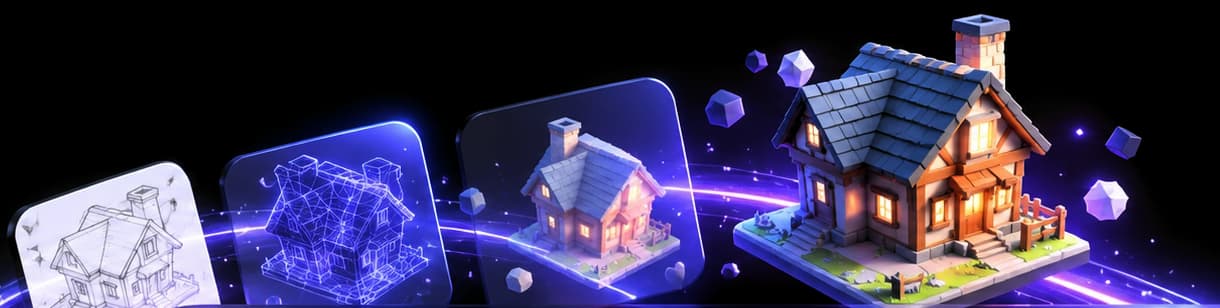
It is machine learning applied to three-dimensional content. The most visible kind generates 3D models from a text prompt, a sketch or a photo. Related kinds rebuild real scenes from photos, as with NeRF and Gaussian splatting, and clean up geometry automatically. The output is usually a textured mesh you can open in Blender or a game engine.
Three jobs people mean by "3D AI"
The phrase covers several technologies that are often lumped together. They do different jobs:
- Generation. Making a new 3D object that did not exist, from a text prompt, a sketch or a photo. This is what most people mean, and what tools like Vi3W, Meshy and Tripo do.
- Reconstruction. Rebuilding a real place or object from many photos or a video. Neural radiance fields (NeRF) and 3D Gaussian splatting are the best known methods. The result is a capture of something real, not a new design.
- Processing. Using learned or algorithmic tools on existing geometry: retopology, UV unwrapping, texture generation, level of detail. Less visible, but it is where much of the practical value is.
What generation actually produces
Most generators produce a textured triangle mesh: the same kind of object a 3D artist makes, stored as GLB, FBX or OBJ. That matters, because a mesh drops into Blender, Unity, Unreal, Godot or a web page with no special software.
Reconstruction methods often produce something else. A Gaussian splat is a cloud of millions of soft, coloured ellipsoids. It renders photorealistically but is not a mesh, so most game engines and modelling tools cannot edit it in the usual way. Gaussian splatting vs meshes explains the difference.
How it got here, briefly
The field moved fast. NeRF (2020) showed that a neural network could represent a scene well enough to render new views of it. DreamFusion (2022) generated 3D from text by borrowing knowledge from 2D image models. Since 2023, models trained directly on large collections of 3D objects, such as LRM, TRELLIS and Hunyuan3D 2.0, have made single-image and text-to-3D fast enough to use in real work. How AI 3D generators work walks through each step.
What 3D AI is good at
- First drafts and blockouts. A model in roughly the right shape, in minutes rather than a day.
- Volume. Background props, set dressing and variations: the fiftieth barrel, not the hero sword.
- Exploration. Turning a concept sketch into something you can rotate, before anyone commits to modelling it properly.
What it is still bad at
- Clean topology by default. Raw generated meshes are usually dense, uneven triangles. They look fine in a render and fight you in an editor. See why AI 3D models have messy topology.
- Exact dimensions and mechanical precision. Generators guess proportions. For a part that has to fit another part, use CAD.
- Rigging and animation. Generators make static meshes. Rigging is still a separate step.
- Whole scenes. Single objects work far better than a full room or level from one prompt.
Where Vi3W fits
Vi3W generates single 3D objects from text, sketches or photos in the browser, then runs automatic retopology to turn the dense high-poly output into a lighter, cleaner mesh before you export it as GLB, FBX or OBJ. It does not rig, animate or build whole scenes, and it is meant as the step before Blender, not a replacement for it. For how artists fit that into their work, read an honest AI 3D workflow for artists.
Last reviewed