
Guides
Hybrid-casual games: the definition, examples, and the art pipeline behind them
What hybrid-casual games are, how they differ from hypercasual, real examples, and the 3D art pipeline the meta layer and live ops demand.
 Aman Porwal on LinkedIn (opens in a new tab)Founder @ Vi3W
3 min read

Quick answer
What are hybrid-casual games?
Hybrid-casual games keep a hypercasual-style core that anyone can play in seconds and add mid-core meta layers such as upgrades, collections and events, monetised through in-app purchases and rewarded ads. Unity says their meta is built to keep players for 60 to 90 days. That longer life needs far more art than hypercasual.
The definition
Hybrid-casual sits between hypercasual and casual. The sources that track the genre describe it the same way:
- Unity: simple, marketable core gameplay with added engagement layers, a deeper meta and a balanced economy built to engage players for 60 to 90 days. It monetises mainly through in-app purchases (IAP) and rewarded video, with interstitials secondary.
- GameAnalytics: the simple core of hypercasual with the features and monetisation of mid-core.
- Adjust: a casual or hypercasual core, plus mid-core meta layers, plus IAP.
The design rule repeated across the industry is that complexity goes in the meta, not the core loop. The first ten seconds stay as simple as a hypercasual game, and the depth lives in upgrades, collections and progression.
Hypercasual vs hybrid-casual
- Core loop: the same idea, one simple action.
- Session goal: hypercasual aims for a quick session and an ad view. Hybrid-casual aims for weeks of return visits.
- Monetisation: hypercasual relies mainly on ads. Hybrid-casual relies on IAP and rewarded video.
- Development time: Unity puts hybrid-casual at 9 to 12 months, against 4 to 5 for hypercasual.
- Art volume: hypercasual needs a handful of assets. Hybrid-casual needs characters, upgrades, cosmetics and event content that keep coming.
Examples
Archero is often described as the first true hybrid-casual game, with one-action controls and a deep upgrade meta. Habby is widely seen as the leader of the genre, and publishers such as SayGames, Homa and Kwalee are active in it. Bowmasters is a common example of an upgrade meta, where players buy better characters with currency earned in play.
Why hybrid-casual is an art problem
Every meta layer is made of content:
- Upgrades: each level of a weapon, vehicle or base looks different.
- Collections: characters, pets and skins players chase.
- Events: seasonal themes and limited items. See our live ops guide.
- Ad creatives: a constant stream of variants for user acquisition. See 3D mobile game ads.
A hypercasual team of two can ship with a few props. A hybrid-casual game needs an art pipeline that can produce dozens of on-style assets every month without a large team.

A practical 3D pipeline for a hybrid-casual team
- Lock the style early. One style sheet with proportions, palette and material rules. Every generated or outsourced asset is judged against it.
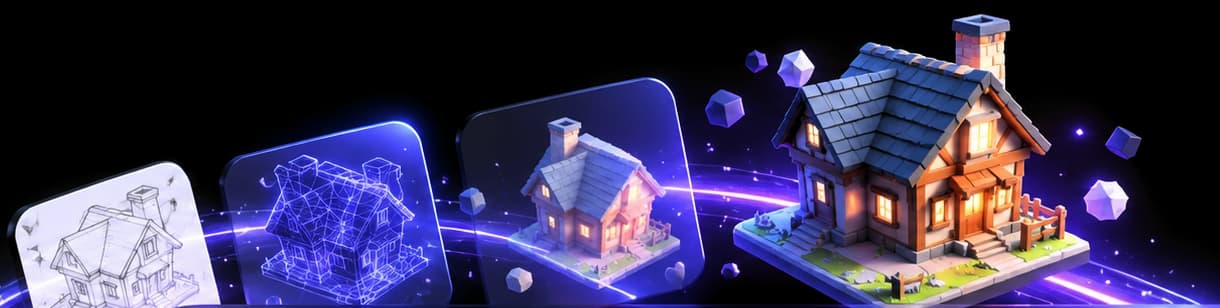
- Generate base assets. Vi3W makes drafts from a text prompt, a sketch or concept art, and lets you compare several of the 25 image-to-3D models on the same image.
- Make upgrade tiers and skins from one mesh. New paint job retextures the same shape by text or reference image, in styles like Gold, Metal, Stone or Cartoon. Tier 1 wood, tier 2 iron and tier 3 gold can share a mesh.
- Keep it mobile-light. Clean shape rebuilds meshes at 500 to 20,000 faces. Mobile props usually sit at the low end.
- Rig characters and pets. Add bones rigs humanoids or animals, and Make it move adds preset moves like Idle, Walk, Run, Jump and Dance.
- Export GLB or FBX into Unity or your engine.
An artist still owns the style pass and the hero assets. The pipeline's job is to make the long tail cheap.
Prototype first
Most hybrid-casual games start as tests. Before you build a full meta, check that the core is marketable. Our guide to game prototypes vs vertical slices explains which build to make at each stage.
Open Vi3W to make your first three upgrade tiers from one mesh.
Frequently asked questions
what is hybrid casual games
Games with a hypercasual-style core that anyone can play in seconds, plus mid-core meta layers such as upgrades, collections and events, monetised mainly through in-app purchases and rewarded video.
hyper casual vs hybrid casual games
Hypercasual games are short-lived and ad-funded with a handful of assets. Hybrid-casual keeps the simple core but adds a meta built to engage players for 60 to 90 days, monetised by IAP, which needs far more art.
hybrid casual games examples
Archero is often called the first true hybrid-casual game. Bowmasters is a common example of an upgrade meta, and Habby, SayGames, Homa and Kwalee are among the companies active in the genre.
Last reviewed