
Guides
Game prototype vs vertical slice: what each proves and how much art it needs
The difference between a game prototype, a vertical slice and a demo, what each proves to publishers, how much art each needs, and how to build them faster.
 Aman Porwal on LinkedIn (opens in a new tab)Founder @ Vi3W
3 min read

Quick answer
What is the difference between a game prototype and a vertical slice?
A prototype tests whether an idea works, so it uses rough or placeholder art and is often thrown away. A vertical slice is a small section of the game built to final quality across art, audio, gameplay and UI, to show publishers or investors what the finished game will be. Prototypes are cheap and fast; slices are expensive.
At a glance
| Build | Question it answers | Art quality | Typical audience |
|---|---|---|---|
| Prototype | Is this mechanic fun or marketable? | Placeholder or rough drafts | The team; a publisher's marketability test |
| Vertical slice | What will the finished game look and feel like? | Final quality, for a small section | Publishers, investors, platform holders |
| Demo | Will players enjoy it enough to buy or wishlist? | Close to final | Players and press |
The short version
A prototype answers "is this worth making?" A vertical slice answers "what will it look like when it's made?" They come at different stages, cost very different amounts and need very different art.
Prototypes: prove the idea
A prototype is the smallest build that tests a mechanic. Art is a means to an end: grey boxes, placeholder models or rough drafts are fine as long as the mechanic reads.
In mobile, prototypes often go further and get marketability-tested with real ads before the game is built. Publishers run a gameplay video to a small audience and judge the concept by cost per install. One published example of targets is Homa Games' hypercasual prototyping page: CPI under $0.40, day-1 retention above 35% and day-3 above 15%. The failure rate is high. Ducky's founder told PocketGamer.biz that developers test about 40 projects on average and shut down 39 before one reaches great metrics.
That number is the strongest argument for fast, cheap prototype art. Most of what you make will be thrown away.
Vertical slices: prove the quality
A vertical slice is a short, complete section of the game (a level, a mission, a few minutes of play) built to final quality in every discipline: art, animation, audio, UI and gameplay. It's called vertical because it cuts through every layer of the game rather than covering a lot of it roughly.
Publishers, investors and platform holders use slices to judge whether a team can deliver. That makes the slice one of the most expensive milestones in pre-production, and the art is the biggest part of it.
Prototype vs vertical slice vs demo
The table above sums it up. A demo is a third thing: a player-facing build, usually for wishlists or sales, which needs final-quality art too.

How much art each needs
Prototype:
- A hero object or character, a few props, a simple environment.
- Readable silhouettes and colours, nothing more.
- Variants, if you're testing themes in ads.
Vertical slice:
- Every asset in the slice at shipping quality: modelled, textured, optimised, rigged and animated where needed.
- A locked art style that the rest of the game will follow.
- Lighting, VFX and UI that match.
Building both faster
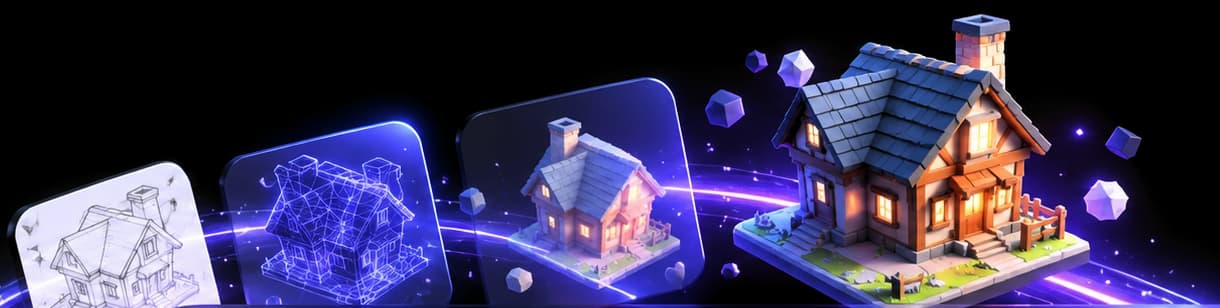
For prototypes, generate drafts instead of modelling from scratch. In Vi3W, a text prompt, sketch or concept image becomes a textured mesh. Clean shape rebuilds it at 500 to 20,000 faces, Add bones and Make it move give a hero preset moves like Walk, Run and Jump, and New paint job makes theme variants for ad tests. Export GLB or FBX into your engine.
For vertical slices, drafts help in two places: blocking out the slice (see 3D blockout) and producing secondary props that an artist then finishes to style. Hero assets in a slice still need an artist's full attention, because the slice is the promise you're making to a publisher.
Which should you build next?
- No proof the idea works: prototype.
- Mechanic proven, pitching for money: vertical slice.
- Funded, building an audience: demo.
For mobile teams moving from a hypercasual-style prototype to a deeper game, our hybrid-casual guide covers the extra art the meta layer needs.
Open Vi3W to draft the asset set for your next prototype.
Frequently asked questions
game prototype vs vertical slice
A prototype tests whether an idea works with rough art and is often thrown away. A vertical slice is a short section built to final quality in every discipline, to show publishers what the finished game will be.
game prototype vs demo
A prototype is an internal or publisher test of an idea. A demo is a player-facing build, usually near final quality, made to win wishlists or sales.
how to prototype a game in under 7 days
Pick one mechanic, use placeholder or generated art, build only what the camera sees, and test with real players or a small ad budget by day five. Speed matters because most prototypes are shelved.
Last reviewed