Guides
3D mobile game ads: making more video creatives from the assets you already have
How mobile game studios make 3D video ad creatives: hooks, formats, variant testing, ad policies and producing new 3D assets fast enough to keep up.
 Aman Porwal on LinkedIn (opens in a new tab)Founder @ Vi3W
4 min read

Quick answer
How do mobile game studios make 3D ads?
They build short video and playable creatives from game-ready 3D assets, usually 15 to 30 seconds with the core mechanic in the first few seconds, then make many variants of the hook, theme and character and let ad network data pick the winners. The limit is how fast new assets and variants can be produced.
Why creatives decide mobile game growth
On today's ad networks, targeting is largely automated. The algorithm finds the audience, and the creative decides whether that audience stops scrolling. That's why mobile user acquisition (UA) teams talk about creative volume: a studio that can test more good ideas each week finds winning ads sooner, and winning ads fade, so the search never stops.
For 3D games, the bottleneck is rarely the editing. It's having enough 3D content to show: new characters, new themes, new obstacles and new settings that make a familiar loop look fresh.
The formats you'll be making
- Gameplay video (15 to 30 seconds). Real or staged gameplay with the core mechanic in the first seconds. Supersonic's prototype-testing guidance warns that making players wait more than about 5 seconds for the engaging part hurts results.
- Playable ads. A tiny interactive version of the game in one HTML file, with strict size limits. See our playable ads guide.
- End cards and statics. A still frame or short loop with the install button, often reused across formats.
- Concept or "what if" ads. Showing a theme or feature you're considering, to test interest. These raise policy questions, covered below.
The hook is what you test
Most variants change one of these and keep the rest:
- The first three seconds: the opening situation, such as a near-fail, a choice or a satisfying chain reaction.
- The theme: the same loop in a different setting (fantasy, sci-fi, Halloween, sport).
- The hero: a different character or vehicle.
- The difficulty framing: "only 1% can solve this" versus a calm satisfying loop.
- The end card.
Themes and heroes are 3D asset problems. Every new one used to mean a modeller's week. That's the part AI generation speeds up.
Producing new 3D content for ads, fast
A practical pipeline for a UA art team:
- Start from what you have. Concept art, a screenshot of an existing character or a quick sketch is enough input.
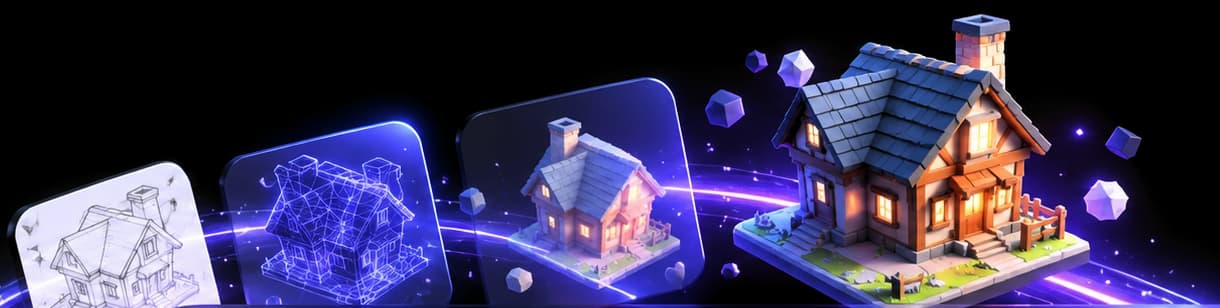
- Generate a draft in Vi3W. Use image to 3D on the concept, or text to 3D for props. Run the same image through several of the 25 image-to-3D models and keep the best.
- Re-skin instead of re-model. New paint job gives the same shape a new look by text or reference image, with styles like Cartoon, Gold, Metal or Stone. That's a theme variant without a new mesh.
- Add motion when the hero needs it. Add bones rigs a humanoid, or a creature with the It's an animal option, and Make it move applies preset moves (Idle, Walk, Run, Jump, Wave, Dance) or a described motion matched to a clip library.
- Export GLB or FBX into the engine or editor you already capture ads in, then light and frame it like the rest of the game.
This doesn't replace an artist's final pass on assets that go into the shipped game. For ads, though, the quality bar is "reads well on a phone for five seconds", and drafts often get there quickly. We haven't timed this pipeline, so measure it on one creative sprint before you plan around it.

Ad policies to respect
Ad networks and app stores have rules against misleading ads, and regulators enforce them. In 2020 the UK's Advertising Standards Authority ruled that two Facebook ads for Playrix's Homescapes and Gardenscapes were misleading. The ads showed pin-pulling puzzles, while the games are mostly match-three, and a "not all images represent actual gameplay" disclaimer didn't save them. Concept ads that show content not in the game carry real risk to your account and your store rating. The safe rule is to show mechanics, characters and themes that exist in the build people will download, or that ship soon after. Check each network's current creative policy before launching a new concept style.
How to measure creative output
Track these per sprint, not per asset:
- Number of new concepts tested (not just resized variants).
- Share of concepts that beat the current control.
- Days from idea to live creative.
- Cost of new 3D content per tested concept.
The last two are where faster 3D drafting shows up. If concepts take a week because a character must be modelled first, the whole test loop slows down. For early-stage games, the same loop is used to decide whether to build the game at all. That is the CPI test, covered in our prototype vs vertical slice guide.
Next step
Take your current best ad and make three theme variants of the hero with New paint job. Open Vi3W.
Frequently asked questions
how do mobile game ads work
Studios pay ad networks to show short video or playable ads inside other apps and on social platforms. The network's algorithm finds the audience; the creative decides whether people install. Studios test many variants and scale the winners.
how are mobile game ads not false advertising
Sometimes they are. In 2020 the UK Advertising Standards Authority ruled two Homescapes and Gardenscapes ads misleading because the puzzles shown weren't representative of the games, despite a disclaimer. Showing real gameplay is the safe rule.
Last reviewed