Guides
AI 3D generation vs photogrammetry vs manual modeling: what does each actually do?
What AI 3D generation really does, how it differs from photogrammetry and hand modeling in accuracy, topology and effort, and when to use each one.
 Aman Porwal on LinkedIn (opens in a new tab)Founder @ Vi3W
5 min read

Quick answer
What does AI 3D generation actually do, and how is it different from photogrammetry or manual modeling?
AI 3D generation predicts a plausible model from a prompt or a few images, using patterns learned from large 3D datasets. Photogrammetry measures a real object from many overlapping photos, so it is accurate but needs the object. Manual modeling is a person building every surface by hand: the slowest, but the only one with full control.
What AI 3D generation actually does
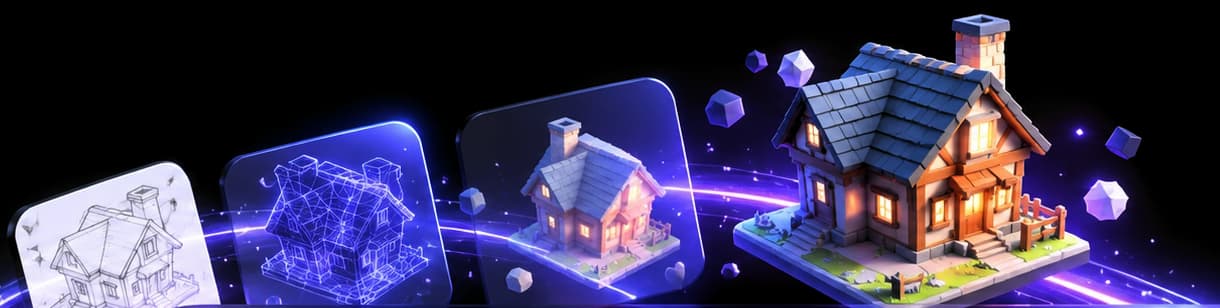
AI 3D generation predicts a 3D model. You give it a text prompt, a sketch or one or a few images, and a neural network trained on a large library of 3D objects produces a mesh and textures that are plausible for that input. It does not measure anything. When it fills in the back of a chair it has never seen, it is drawing on what the backs of chairs usually look like.
That one fact explains how AI 3D generation is different from photogrammetry or manual modeling:
- Photogrammetry measures. It reconstructs a real object that exists, from photos of every side.
- Manual modeling decides. An artist places every surface on purpose.
- AI generation infers. It invents a convincing answer from limited input.
Each is the right tool for a different job, and most professional pipelines use more than one.
How AI 3D generation works, briefly
Current generators are trained on hundreds of thousands of 3D assets. TRELLIS, for example, was trained on about 500K objects according to its paper. Given your input, the model generates a shape in its own internal format, converts it to a triangle mesh, and paints textures on it. The result needs no physical object, no capture session and no modelling skill to start, and works from concept art, a photo of something you do not own, or just words. How text-to-3D works covers the stages in detail.
What you get: a dense, evenly triangulated mesh with generated textures. What you do not get: real-world dimensions, guaranteed accuracy on unseen sides, or topology planned for animation.
How photogrammetry is different
Photogrammetry finds the same points across many overlapping photos and triangulates their positions in 3D. Because it measures, it is faithful to the real object, including its surface texture and colour.
It also has hard requirements. Epic's RealityScan documentation says you can take up to 250 images in the mobile app and recommends "getting close to that number". It warns that "smooth or reflective surfaces can cause issues" and that glass objects "may not be reconstructed at all", and suggests a scanning spray. Matte, colourful, textured objects scan best.
What you get: an accurate but heavy mesh of the object and some of its surroundings, which you will crop, clean and usually retopologise. What you cannot do: scan something that does not exist, or fix a design while you capture it.

How manual modeling is different
Manual modeling means building the object yourself in software such as Blender, Maya or ZBrush: pushing vertices, extruding faces, sculpting forms, then laying out clean topology, UVs and materials. It is slower and it takes skill, but every decision is yours.
That control matters most where automation is weakest. Blender's own manual, in its retopology section, says topology for a mesh that will be animated "has to follow the flow of the geometry, and no perfect automatic tools exist for this right now; it has to be done manually." Hero characters, anything that deforms, and assets that must match a style guide exactly are still hand-built or hand-finished.
AI vs photogrammetry vs manual modeling, compared
- Input. AI: text, a sketch or a few images. Photogrammetry: the physical object and dozens to hundreds of photos. Manual: references and your time.
- Accuracy to a real object. AI: approximate, with unseen sides guessed. Photogrammetry: high, it is measured. Manual: as accurate as your references and patience.
- Can make things that don't exist. AI: yes. Photogrammetry: no. Manual: yes.
- Topology. AI: dense triangles, needs retopology. Photogrammetry: very dense, noisy, needs retopology. Manual: clean, built for purpose.
- Effort to a first result. AI: one generation run. Photogrammetry: a capture session plus processing. Manual: the longest, often days for a detailed asset.
- Skill needed. AI: low to start, higher to finish. Photogrammetry: careful capture technique. Manual: the most.
- Weak spots. AI: thin parts, text, exact dimensions. Photogrammetry: glass, chrome, shiny or featureless surfaces. Manual: time.
Which should you use?
- Use AI generation for concepts, blockouts, background props, variations, and objects you only have a picture of.
- Use photogrammetry for real things that must look exactly like themselves: products you sell, heritage objects, natural rocks and bark for a game.
- Use manual modeling for hero assets, anything rigged and animated, mechanical parts with precise dimensions, and final art that defines a style.
They work best combined
The methods are not rivals. A common pattern is to generate a quick AI version to agree on the shape, then remodel or retopologise the parts that matter by hand. Another is to scan a real object and use AI or manual work to fill in the parts the scan missed. Photogrammetry vs AI image to 3D goes deeper on the scanning side, and Gaussian splatting vs meshes covers the newer capture method that is not a mesh at all.
When not to use AI 3D generation
- You need the exact shape of a real object you own. Scan it.
- You need precise dimensions or a mechanical fit. Model it in CAD.
- You need a character that deforms cleanly in animation. Plan to retopologise or model it by hand.
- Your art style is very specific. Generated assets drift toward the average of their training data.
Where Vi3W fits
Vi3W is an AI generation tool, not a scanner and not a replacement for Blender. It turns text, a sketch or an image into a textured mesh in the browser, adds AI PBR textures, can retopologise from high-poly to low-poly, and exports GLB/glTF, FBX or OBJ for the manual finishing step. If your object exists and you can photograph it from every side, photogrammetry will be more faithful. Whether AI will take over the manual part is a separate question, covered in is 3D modeling going to be replaced by AI.
Frequently asked questions
what does "ai 3d generation" actually do, and how is it different from photogrammetry or manual modeling?
AI 3D generation guesses a complete, textured mesh from text or one or more images, based on what similar objects looked like in its training data. Photogrammetry reconstructs a real, existing object by matching points across dozens or hundreds of photos. Manual modeling is an artist building the shape in software such as Blender. AI is fastest, scanning is most faithful to a real object, and manual work gives the cleanest, most controllable result.
Last reviewed