Guides
Is 3D modeling going to be replaced by AI?
Which parts of 3D modeling AI already automates, which it can't, what the job data says, and which modeling skills are worth learning in 2026.
 Aman Porwal on LinkedIn (opens in a new tab)Founder @ Vi3W
5 min read

Quick answer
Is 3D modeling going to be replaced by AI?
Not as a skill, but parts of the job are being automated. AI already produces first drafts, background props and variations from text or images. It does not reliably produce animation-ready topology, exact dimensions, a consistent art style or judgement about what a scene needs, so modelers who direct and finish AI output are the ones most in demand.
The short answer
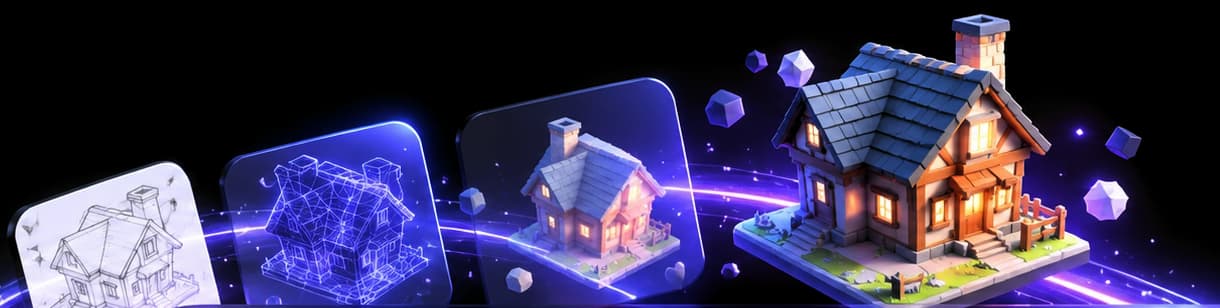
3D modeling is not going to be replaced by AI as a skill, but it is being split in two. The fast, repetitive end of the work (first drafts, filler props, variations) is increasingly generated. The careful end (topology that animates, exact dimensions, a consistent style, final polish and the decision of what to make in the first place) is still done by people, and in 2026 there is no tool that does it reliably on its own.
So the useful question is not "will AI replace 3D modeling?" but "which parts of 3D modeling will I still be doing?" This guide answers that task by task. If your worry is the profession rather than the craft, our companion piece, is AI replacing 3D artists?, covers it from a tool maker's side.
What AI already does well
Current AI 3D generators turn a prompt, sketch or image into a textured mesh. They are genuinely good at:
- Blockouts and concepts. A rough version of an idea to agree on shape and scale before anyone spends a day on it.
- Background and filler props. The fiftieth barrel, crate or rock in a level, where nobody looks closely.
- Variations. Five versions of a lamp to pick from, instead of one.
- Objects you only have a picture of. A reference image becomes a starting mesh.
Assistants are also starting to operate the software itself. Onshape's FeatureScript MCP server, still in early access, lets an assistant write parametric CAD features, and Blender has an official MCP server covered in Blender MCP explained. These automate clicks and scripts, not taste.
What AI still cannot do reliably
- Topology for animation. Raw AI meshes are dense triangles. Blender's own retopology documentation says topology for animated meshes "has to follow the flow of the geometry, and no perfect automatic tools exist for this right now; it has to be done manually." See what an AI mesh generator actually outputs.
- Exact dimensions. Generators output meshes, not CAD solids. A part that must fit a bolt pattern is still modelled.
- A consistent style across a project. Generated assets drift towards the average of their training data. Matching a style guide across hundreds of assets is human direction.
- Hero assets. The main character, the weapon on screen in every frame, the product on the box. These get the most scrutiny and the most hand work.
- Judgement. Knowing what a scene needs, what to cut and what reads well at game camera distance is not a generation problem.

What the job data says
The numbers point to change, not disappearance.
- US employment outlook. The Bureau of Labor Statistics' outlook for special effects artists and animators, last modified October 29, 2026, projects "little or no change" in employment from 2025 to 2035, with about 4,200 openings a year. It lists about 51,900 jobs in 2025 and a median pay of $102,030 in May 2025. That is a flat market, not a vanishing one.
- How game developers feel. GDC's 2026 State of the Game Industry report, based on more than 2,300 professionals, found 36% use generative AI tools at work, while 52% think it is having a negative impact on the industry. Visual and technical artists were the most negative group, at 64%.
Read together: adoption is real, artists are wary, and demand for the work has not fallen off a cliff. What is changing is which tasks fill a modeler's day.
Task by task: automated, assisted or still human?
- Concept blockouts: largely automated. Generate, pick, adjust.
- Background props: largely automated, with a human check for scale, style and poly count.
- Texturing: assisted. AI PBR textures are a strong start; seams, wear and style matching are hand work.
- Retopology: assisted for static props, mostly human for characters and anything that deforms.
- UV unwrapping: assisted. Automatic unwraps are fine for many props, not for hero assets with painted textures.
- Hard-surface and CAD parts: mostly human, with early text-to-CAD tools appearing.
- Characters and creatures for animation: human-led, with AI meshes as sculpting bases.
- Art direction and style: human.
Which 3D modeling skills are worth learning now
If you are learning or deciding whether to, put your time where AI is weakest:
- Topology and retopology. Knowing why an edge loop goes where it goes is exactly what generators lack. Start with Blender retopology.
- Cleanup and optimisation. Turning a heavy generated mesh into a game-ready asset is now a daily task. Clean up an AI-generated 3D model shows the steps.
- Form and silhouette. Sculpting and traditional modeling train your eye, which is what lets you judge AI output.
- Technical constraints. Poly budgets, texture sizes, engine import rules. These decide whether an asset ships.
- Directing generation. Writing good prompts and choosing inputs is a small skill, but it compounds.
How to start learning 3D modeling has a path for beginners.
When the fear is justified
Be honest with yourself about one area: if your work is mainly volume production of simple, generic props at low prices, that is the slice most exposed to generation. The response that works is moving up the chain, towards finishing, optimisation, style and heroes, not competing with a generator on speed.
Where Vi3W fits
Vi3W is built for the automated end of this split. It turns text, a sketch or an image into a textured model in the browser, adds AI PBR textures, retopologises from high-poly to low-poly, and exports GLB/glTF, FBX or OBJ so you can finish the asset in Blender or your engine. It does not rig, animate, build scenes or make CAD solids, and it is not a replacement for knowing how to model. It replaces the part you keep putting off. For a practical workflow, see AI 3D workflow for artists.
Frequently asked questions
is 3d modeling going to be replaced by ai
Not entirely, and not soon. AI handles the fast, repetitive end of 3D modeling: blockouts, filler props and quick concepts. Clean topology for animation, precise engineering parts, style consistency and final polish still need a person. The US Bureau of Labor Statistics projects little or no change in employment for special effects artists and animators from 2025 to 2035, not a collapse.
Last reviewed