Guides
CGI ads: what they mean, how they're made, and why brands use them
What CGI ads are, the main types including FOOH and 3D billboards, how they're produced step by step, and where AI-generated 3D models fit.
 Aman Porwal on LinkedIn (opens in a new tab)Founder @ Vi3W
3 min read

Quick answer
What are CGI ads?
CGI ads are advertisements made fully or partly with computer-generated imagery: 3D-modelled products, characters or effects rendered on their own or composited into real footage. They range from clean product videos to surreal social clips such as "fake out-of-home" (FOOH) stunts, where a giant product appears in a real city street.
What CGI means in advertising
CGI stands for computer-generated imagery. In advertising, it covers anything built in 3D software rather than filmed: a product that spins and explodes into parts, a mascot that talks, a sneaker the size of a bus parked on a real street.
The main types of CGI ads
- Product CGI: studio-style product videos and stills. See 3D product animation.
- Character and mascot CGI: animated brand characters.
- Mixed reality, or VFX: CGI composited into real footage, with a camera track so the 3D object sits in the shot.
- FOOH (fake out-of-home): social videos that look like real outdoor stunts. The digital artist Ian Padgham, who coined "faux out of home", made two of the best-known examples: Maybelline's London tube train with giant lashes (July 2023) and Jacquemus handbags driving through Paris.
- Anamorphic 3D billboards: real screens playing content designed to look 3D from the street. See 3D billboards.
Why brands use CGI ads
- Impossible visuals stop the scroll on social feeds.
- No physical production: no location permits, no product samples, no reshoots.
- Reusable assets: one product model feeds ads, product pages and AR.
- Speed of variation: new colourways, seasons and markets from the same scene.
There's a debate too. Critics argue that FOOH works by fooling viewers, while defenders say talkability is the point. If you make realistic stunt-style CGI, consider labelling it as CGI. Some platforms and markets have rules about realistic synthetic media in ads, so check where you'll run it.
How a CGI ad is made
- Concept and storyboard: the idea and the shot list.
- Plate shoot (for mixed reality): film the real location, with camera data or tracking markers.
- 3D assets: model the product, characters and props.
- Animation and simulation: motion, cloth, fluids and particles.
- Lighting and rendering: match the light in the plate.
- Compositing: blend 3D into footage, add shadows, reflections and grain.
- Edit and sound.
Want to do it yourself? CGI ads in Blender walks through a mixed-reality ad step by step.

Where AI fits in CGI ads
AI image and video generators can make CGI-looking clips from prompts, but they're hard to keep on-brand and consistent shot to shot. Many studios use AI for concepting and keep a 3D pipeline for the final, because a 3D model looks the same from every angle and in every shot.
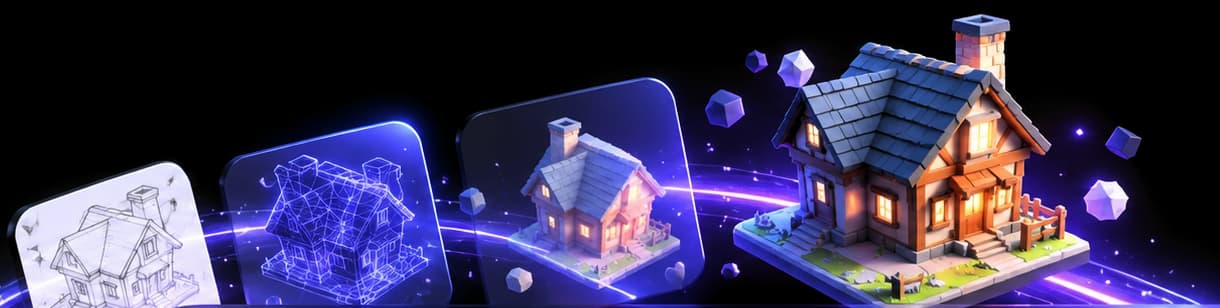
AI 3D generation speeds up the asset step. Vi3W turns a product photo, a sketch or a description into a textured 3D model, with 25 image-to-3D models to compare on the same image. New paint job gives the same model a new look (Gold, Metal, Stone, Cartoon and more), and Add bones and Make it move rig and animate a mascot with preset moves like Wave and Dance. Download GLB, FBX or OBJ for free and bring it into Blender, Cinema 4D or Unreal.
For hero shots of a real product, expect to refine the model by hand. For stylised props, background objects and mascots in social clips, drafts often go a long way.
What CGI ads cost
Costs vary from a few hundred dollars for a simple social loop to studio budgets for a full campaign. Our CGI ad cost guide breaks it down, and CGI ads vs UGC ads helps you decide when CGI is worth it.
Open Vi3W to make the 3D assets for your next CGI ad.
Frequently asked questions
cgi ads meaning
Ads made fully or partly with computer-generated imagery: 3D-modelled products, characters or effects, rendered on their own or composited into real footage.
cgi ads for brands
Brands use CGI for launches, products with interesting insides, scroll-stopping social hooks and campaigns that need many colourways or markets from one model.
cgi ads with ai
AI video and image generators help with concepts, but are hard to keep consistent. Many studios use AI for ideas and 3D for finals; AI 3D generators speed up the model step.
Last reviewed