
Geometry
Quad topology
A way of building a polygon mesh almost entirely from four-sided faces arranged in continuous rows called edge loops.
- #geometry
- #modeling
- #retopology
- #uv-mapping
Quick answer
What is quad topology?
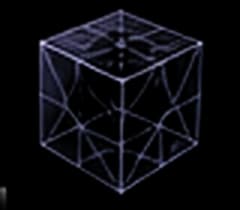
A way of building a polygon mesh almost entirely from four-sided faces arranged in continuous rows called edge loops. Meshes built this way subdivide smoothly, deform predictably when animated, unwrap cleanly for texturing and are easy to edit with loop tools, which is why modellers treat it as the standard for editable assets.
Why modellers prefer quads
The case for quads is mostly about editing. Four-sided faces line up into edge loops: rings of faces you can select with one click, cut through with a loop cut, slide along the surface or delete as a unit. A triangle or n-gon interrupts the ring, and loop tools stop at it. On a mesh you are still shaping, that difference decides whether a change takes one click or twenty.
Quads also subdivide cleanly. A Subdivision Surface modifier splits each quad into four smaller quads and smooths the result. On a clean quad mesh that gives predictable curvature. Triangles and n-gons subdivide into awkward patterns that show up as pinches and bumps in the shading.
Deformation follows the same logic. When a rigged mesh bends at an elbow or a mouth opens, evenly spaced quad loops stretch and compress smoothly. Irregular triangles crease. That is why character topology is built from loops that follow muscles and joints.
Quads, triangles and n-gons
Every polygon mesh is made of faces. A triangle has three sides and is always flat, which is why graphics hardware draws nothing else. A quad has four. An n-gon has five or more.
Game engines triangulate everything on import, so the question is never which face type the GPU sees. It is which face type is best to work with before export. For that, quads win wherever the mesh will be edited, subdivided or deformed, and triangles or n-gons are acceptable on flat areas that will not be touched again.
Quad topology and AI-generated models
Most AI 3D generators reconstruct a mesh from a learned shape, and the direct output is usually a dense mass of triangles: the form is right, but there are no loops to select and nothing that subdivides cleanly. For a static background prop that rarely matters. For anything you plan to edit, subdivide or animate, the mesh needs retopology into quads first.
That is why "quad topology" has become the main thing to check when comparing AI 3D tools. A model can look identical in a render and be completely different under the wireframe.
Quads, triangles and n-gons compared
| Feature | Quads | Triangles | N-gons |
|---|---|---|---|
| Subdivision | Smooth and predictable | Can pinch and leave artefacts | Unpredictable; often creases |
| Edge loops and loop selection | Yes | Loops stop at triangles | Loops stop at n-gons |
| Deformation | Best | Fine in areas that do not bend | Poor |
| Game engine rendering | Triangulated on import | Native | Triangulated on import |
| Where they belong | Anything you will edit or animate | Flat areas and final game meshes | Flat hard-surface faces you will not subdivide |
Frequently asked questions
are ngons a good or bad idea?
Neither, it depends where they are. An n-gon (a face with five or more sides) is harmless on a flat surface that will never be subdivided or deformed, such as a wall or the top of a table. It causes problems on curved surfaces, under a Subdivision Surface modifier, and anywhere the mesh bends, because n-gons subdivide unpredictably and block edge loops.
If I make quad faces because Blender prefers it but I need tris for the game engine, am I not causing a problem?
No. Game engines triangulate every face on import, so modelling in quads costs nothing at runtime. You keep quads while modelling because they are easier to edit, unwrap and subdivide. If you want control over exactly how each quad is split, triangulate it yourself before export, for example with Blender's Triangulate modifier.
When is it ok to use tris, pentagons, or hexagons?
Use triangles and n-gons where the surface is flat and will not deform or be subdivided: the underside of a prop, a panel on a hard-surface model, the end cap of a cylinder. On a game mesh that is already final, triangles are normal. Avoid them on curved, subdivided or animated areas, where they cause pinching, shading artefacts and broken edge loops.
Related terms
- RetopologyRetopology is the process of rebuilding a 3D model's surface with a new, cleaner polygon layout while keeping its shape.
- UV mappingThe process of flattening a 3D model's surface into a 2D layout so a texture image can be wrapped onto it.
- Level of detail (LOD)A rendering optimisation that swaps a model for simpler versions as it gets smaller on screen.
- Text to 3DGenerating a three-dimensional model from a written description.
Sources & further reading
From text to 3D
Create 3D models with AI in seconds.
Turn ideas into game-ready 3D models from text, a sketch or an image. No complex software — it all runs in your browser.

Last reviewed