Guides
Midjourney to 3D: turn a Midjourney image into a real 3D model
Midjourney makes images, not meshes. The prompt parameters that give a clean 3D input, how to turn the image into a model, and what to check.
3 min read

Quick answer
Can you turn a Midjourney image into a 3D model?
Yes. Midjourney only outputs images and video, so you add an image-to-3D step. Prompt for one object, whole, on a plain background, using parameters like --no and --ar to remove clutter and frame it. Then upload the image to a 3D generator and export the mesh as GLB, FBX or OBJ.
Midjourney's job, and the next tool's job
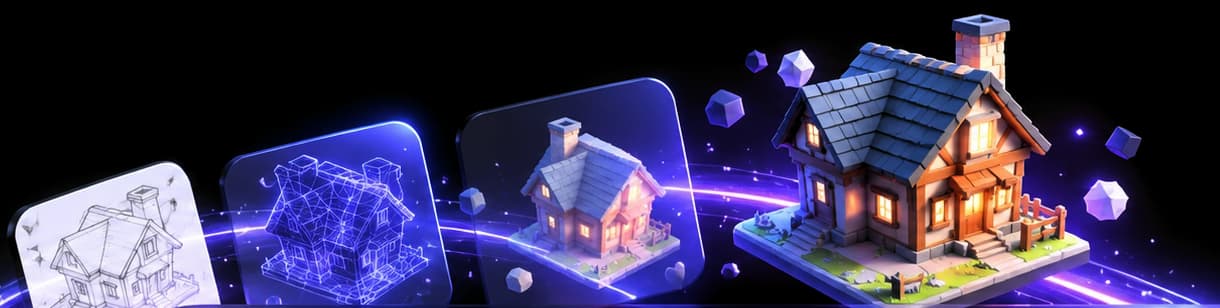
Midjourney is very good at the concept: the silhouette, the materials, the mood. It does not export 3D files. What you need from it is one picture an image-to-3D generator can read, and Midjourney's defaults work against that: painterly backgrounds, cropped edges, dramatic lighting, wide cinematic frames.
So the work is mostly in the prompt.
Prompting Midjourney for a 3D-ready image
Write the object first, then the presentation:
stylised fantasy lantern, brass and green glass, full object in frame, centred, front view, plain white background, soft studio lighting --no shadow, text, scenery --ar 2:3
What each part is doing:
- "full object in frame, centred" stops the crop. A generator cannot rebuild a handle it cannot see.
- "plain white background" with --no scenery gives the generator a clean edge to separate the object from.
- --no shadow, text removes the cast shadow (which can be modelled as a floor) and the stray lettering Midjourney likes to add.
- --ar 2:3 for tall things, --ar 3:2 for long ones, so the object fills the frame instead of floating small in the middle.
- Front or three-quarter view. Straight on is safest. A slight three-quarter view shows depth, but keep it slight.
If Midjourney insists on a dramatic look, lower the stylisation or try --style raw, which follows the prompt more literally.
A series that matches
Making a set of props for one game? Generate them with the same style words, or use Midjourney's style or image references, so the set reads as one world. The 3D step will carry that style through, mostly. Consistent art style across AI 3D assets covers the rest.
From image to mesh
Upscale the chosen image, download it, and upload it to an image-to-3D tool. In Vi3W, upload it as the image and go straight to the 3D step, choosing the 3D model by cost and quality. The default, TRELLIS, runs on every plan.
Check the result from every side. Midjourney images often have one perfect side and an impossible one (a strap that goes nowhere), and the generator has to invent the back. If the back matters, generate a back view in Midjourney and add it as an extra angle: multi-view image to 3D.
What comes out
Vi3W retopologises the mesh and exports GLB, FBX or OBJ, so the model opens in Blender, Unity, Unreal, Godot or a slicer. Painterly Midjourney textures usually survive the trip as a hand-painted look, which suits stylised games well and photoreal ones less.
Licensing, quickly
What you may do with a Midjourney image depends on your Midjourney plan and its terms. Check those before selling anything made from it. The 3D step does not change the rights to the original picture.
Try it
Upload your Midjourney image to Vi3W and turn it around for the first time.
Last reviewed